
Digital Marketing
Why You Must Hire SEO Specialist Expertise Before a Website Redesign
🕑 9 min read 💻 Digital Marketing

It is one of the most common opportunities to protect your digital growth:
A company invests $30,000 to $100,000 + into a sleek, modern website redesign. The leadership team is thrilled with the aesthetic upgrades: modern typography, fluid animations, and high-converting visual layouts. The site goes live to internal celebration.
Then, two weeks later, the full impact on search visibility becomes clear.
To preserve organic search traffic, inbound leads, and keyword rankings across high-intent commercial terms, proactive SEO integration is essential. By partnering with search specialists, you ensure seamless continuity and protect your revenue streams.
This scenario highlights the importance of combining visual aesthetics and front-end development with robust search engine architecture to achieve sustainable success.
During a redesign, thoughtfully managing URL slugs, optimizing legacy page copy, mapping heading hierarchies, and executing 301 redirects protects years of accumulated domain authority.
To safeguard your digital equity, ensure smooth traffic transitions, and guarantee your new site outperforms the old one, hiring SEO specialist expertise before writing a single line of redesign code is essential.
In this guide, we break down how website redesigns can secure organic rankings, outline the technical migration roadmap, and reveal how RadarHire connects you with elite search specialists who maximize your revenue.
Executive Summary: Protecting Your Digital Real Estate
- The Redesign Opportunity: Redesigning or migrating a website with technical search oversight secures consistent organic traffic by flawlessly preserving URLs, metadata, and 301 redirects.
- Aesthetics vs. Architecture: Web designers build for human visual appeal; search engines crawl structured code, internal links, canonical tags, and schema architecture.
- The Strategic Mandate: You must hire SEO specialist talent during the wireframing and pre-launch phases—not after launch—to audit legacy authority, map redirects, preserve keyword equity, and optimize technical crawlability.
The Anatomy of an SEO-Optimized Redesign
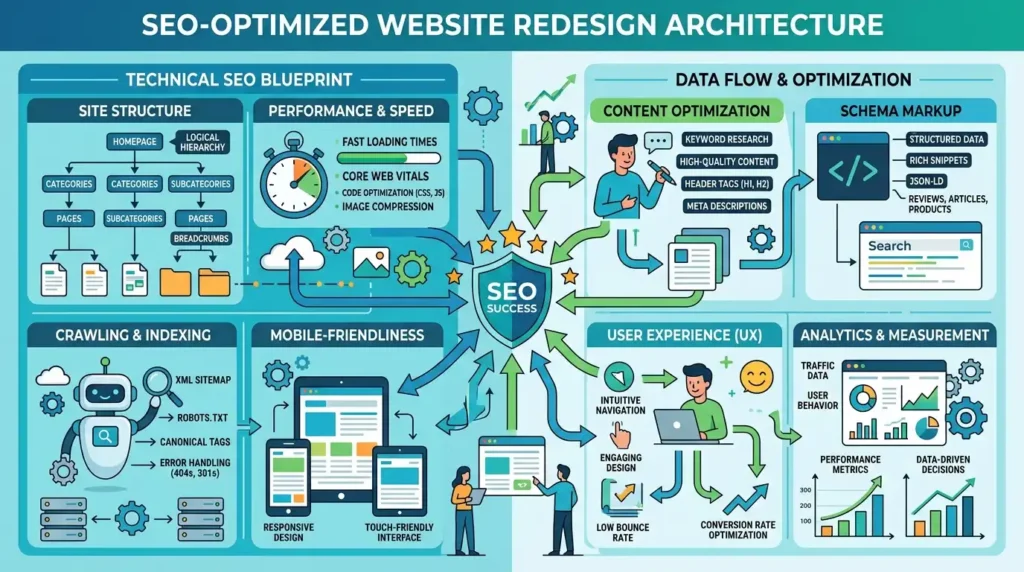
When a website is redesigned, nearly every fundamental element search engine algorithms rely on to rank your pages undergoes radical change:
THE OPTIMIZED REDESIGN SUCCESS:
[ Beautiful New Site Deployed ] -> [ Changed URLs & Broken Links ] -> [ 404 Errors & Lost Backlinks ] -> [ 80% Traffic Drop Overnight ]
THE SEO-PROTECTED MIGRATION ENGINE (Compounding Growth):
[ Legacy Crawl & URL Mapping ] -> [ 1:1 301 Redirect Architecture ] -> [ Pre-Launch Staging Audit ] -> [ Seamless Rank Retention & Growth ]
4 Hidden Killers of Organic Rankings During a Redesign:
- Mapped URL Continuity: If your old high-ranking URL was yourdomain.com/services/b2b-staffing and the new design renames it yourdomain.com/solutions/staffing, a permanent 301 redirect ensures Google instantly transfers all accumulated search equity, ranking history, and inbound backlinks.
- Stripping Out SEO-Rich Content: Designers love clean, minimalist layouts. In an effort to make pages look sleek, they often delete in-depth descriptive text, FAQs, and heading tags that were the exact semantic signals Google used to rank the page #1.
- Optimized Internal Linking Structure: Updating your site’s navigation menus, footer links, and contextual in-body links enhances the flow of PageRank across your domain, making high-value subpages easily discoverable by search bots.
- Streamlined JavaScript Crawling & Core Web Vitals: Modern web design frameworks can be optimized by managing client-side JavaScript rendering, streamlining animations, and compressing media assets to boost page speed and help search engine bots seamlessly parse content.
5 Critical Reasons to Hire SEO Specialist Talent Before Redesigning
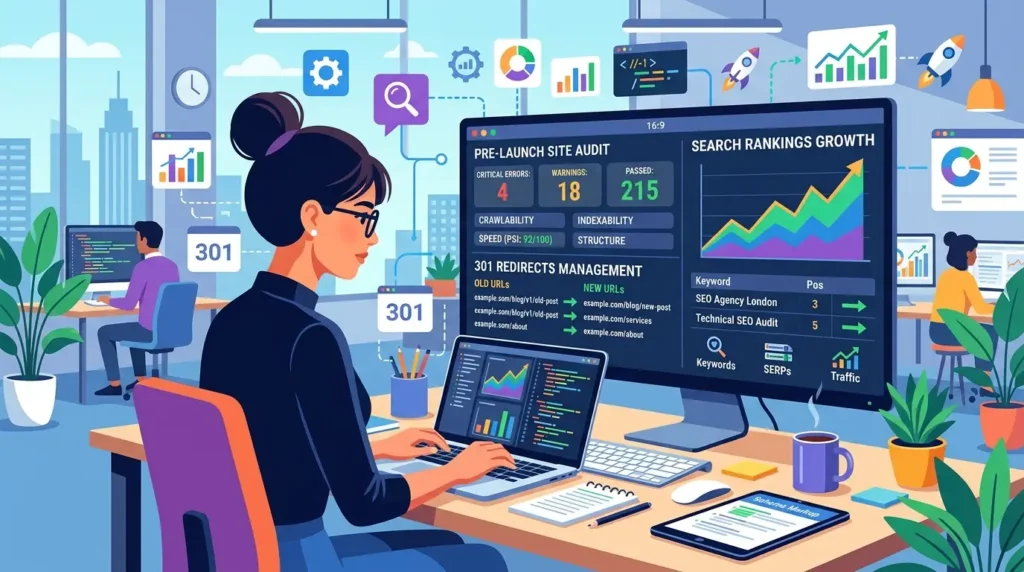
Bringing in an expert early ensures a strong foundation for your digital architecture. Here is why you must secure SEO specialist guidance from the very beginning of the project:
THE PRE-REDESIGN SEO ARCHITECTURE CHECKLIST:
1. Comprehensive Legacy Domain & Keyword Equity Audit (Benchmarking top revenue URLs)
2. 1:1 Granular 301 Redirect Mapping (Preserving backlink power & indexing history)
3. Information Architecture (IA) & URL Structuring (Building scalable folder logic)
4. Content & On-Page Semantic Preservation (Protecting headings, copy & metadata)
5. Pre-Launch Staging Server Audit (Catching noindex tags, crawl blocks & broken tags)
1. Auditing and Protecting Legacy Keyword Equity
Before touching a single page, an SEO specialist crawls your existing website to identify your most valuable digital assets:
- Revenue URLs: Which specific URLs drive 80% of your organic revenue and pipeline?
- Backlink Profiles: Which pages hold valuable high-authority backlinks from external publications?
- Ranked Keywords: What keyword queries currently trigger top-3 rankings?
This audit creates an untouchable “Protection Blueprint” ensuring design teams do not alter or delete high-performing pages.
2. Engineering a Flawless 1:1 301 Redirect Map
If URLs must change during a site restructure, an SEO specialist authors a granular, line-by-line 301 redirect map.
They ensure that every legacy URL points to the exact, most semantically relevant new equivalent page. This preserves link equity, maintains backlink authority, and guarantees that users clicking external links never encounter a broken 404 page.
3. Designing a Scalable Information Architecture (IA)
A redesign is the best opportunity to refine and streamline website hierarchies. An SEO specialist structures your URL taxonomy (e.g., categorizing /services/ or /locations/ logically) to optimize crawl budget, improve internal link distribution, and enhance user navigation paths toward conversion goals.
4. Safeguarding On-Page Semantic Signals
Designers focus on how words look; search specialists focus on what words mean to algorithms. An SEO specialist reviews new wireframes to ensure:
- Keyword & Entity Density: Core keyword density and semantic entities are maintained.
- Heading Hierarchies: Proper H1, H2, and H3 header hierarchies are implemented.
- Metadata Preservation: Custom title tags, meta descriptions, alt text, and Open Graph tags are transferred without loss.
- Structured Schema Data: Structured data (Schema markup such as Organization, Article, FAQ, and Product schema) is embedded cleanly into page templates.
5. Conducting Rigorous Pre-Launch Staging Audits
Prior to pointing DNS records to the new site, an SEO specialist audits the staging environment:
- Robots & Directives: Verifying that indexing directives in the robots.txt file are perfectly configured before going live to guarantee maximum search visibility.
- Technical Integrity: Testing canonical tags, XML sitemaps, and mobile responsiveness.
- Core Web Vitals: Ensuring Core Web Vitals (LCP, FID/INP, CLS) meet Google’s performance thresholds.
Side-by-Side Comparison: Web Design Agency vs. Dedicated SEO Specialist
Migration & Launch Task
Typical Web Design / Dev Agency
Dedicated SEO Specialist (RadarHire)
Primary Project Goal
Visual aesthetics, animations & launch speed
Traffic preservation, technical indexing & revenue growth
Legacy URL Mapping
Generalized catch-all redirects (or none)
Granular 1:1 301 redirect matrix for every URL
Content Strategy
Trims copy for visual minimalism
Preserves semantic intent, E-E-A-T & ranking keywords
Technical Crawl Auditing
Basic broken link scan
Deep crawl analysis (Schema, canonicals, server logs, speed)
Post-Launch Protocol
“Site is live, contract fulfilled”
Daily index tracking, Search Console audits & error triage
Accountability for Rankings
Zero accountability for organic drops
Directly accountable to organic traffic & keyword stability
Post-Launch Day: The First 72 Hours of Migration Governance
Even with meticulous preparation, the first 72 hours following a redesign launch are critical. When you hire SEO specialist expertise through RadarHire, your specialist actively manages post-launch triage:
POST-LAUNCH 72-HOUR MONITORING PROTOCOL:
> Hour 0-4: Verify DNS propagation, SSL certificates & remove staging ‘noindex’ tags.
> Hour 4-12: Submit updated XML sitemaps directly to Google Search Console & Bing Webmaster.
> Hour 12-24: Execute live crawl of all 301 redirects to eliminate redirect chains & 404 loops.
> Hour 24-48: Audit live Google Analytics 4 (GA4) tracking, conversion pixels & goal funnels.
> Hour 48-72: Monitor real-time indexing status and crawl frequency in Google Search Console.
By actively monitoring server response codes, crawl logs, and real-time indexing, an SEO specialist resolves potential indexing bottlenecks within minutes—ensuring stable and predictable search performance.
Why Sourcing Your SEO Specialist Through RadarHire Protects Your ROI
Finding a search professional with deep technical migration expertise is notoriously challenging. Many generalist marketers understand basic keyword research but lack the technical background to audit server responses, write RegEx redirect rules, or diagnose JavaScript rendering issues.
At RadarHire, we connect high-growth businesses with the top 1% of pre-vetted global search talent:
- Vetted Technical Migration Mastery: Our specialists are tested on complex site migrations, redirect architectures, Schema implementation, and technical crawl recovery.
- 100% Time-Zone Synchronization: Talent works during your core U.S. business hours (EST, CST, MST, PST) for live Slack collaboration with your design and development teams.
- Turnkey Compliance & HR Management: We handle international contracts, local compliance, benefits, and cross-border payroll seamlessly.
- 50% to 65% Cost Optimization: Secure senior, dedicated technical SEO expertise at a fraction of domestic recruiting agency markups.
Frequently Asked Questions (FAQs)
Why does organic traffic drop after a website redesign?
Traffic drops after a redesign when URLs are changed without proper 301 redirects, high-ranking content is stripped away, internal links are broken, or technical tags (like noindex or broken canonicals) prevent search engines from crawling the new site properly.
When should I hire an SEO specialist for a website redesign?
You should hire an SEO specialist at the very beginning of the redesign process—during the information architecture, wireframing, and content planning stages. Involving SEO early ensures that page structures, content depth, and URL paths are designed for search visibility before development starts.
Can a web development agency handle the SEO migration for me?
While developers can write redirect rules, they typically lack deep expertise in search intent preservation, keyword ranking protection, semantic entity mapping, and search engine algorithm nuances. A dedicated SEO specialist ensures your commercial search equity is fully protected.
Protect Your Rankings and Revenue with RadarHire
Ensure your beautiful new website amplifies years of hard-earned search rankings. Partner with RadarHire to hire SEO specialist talent who will safeguard your traffic, engineer a flawless technical migration, and turn your redesign into a powerful organic growth engine.