Nearshore Staffing
Supercharging Your Agile Sprints: The Technical Edge of Nearshore Staff Augmentation
🕑 12 min read 💻 Nearshore Staffing

In modern software development, Agile methodology is the universal operating system. Designed around two-week sprint cycles, continuous integration, daily stand-ups, and real-time pair programming, Agile was built to optimize for one primary metric: feedback loop velocity.
The faster a software engineering team can identify a blocker, clarify an edge-case user story, review a pull request (PR), and push a commit to staging, the faster the business can deploy value to production.
Yet, when U.S. engineering organizations expand their capacity through traditional offshore outsourcing in Asia or Eastern Europe, the core machinery of Agile completely breaks down.
When your remote developers are 10 to 12 hours ahead or behind:
- Daily stand-ups devolve into disjointed, asynchronous Jira status reports.
- Talent: By seamlessly integrating top-tier global talent into your engineering pods, teams maintain sustainable workloads, ensuring high code quality, peak productivity, and consistent on-time releases.
- Pull request reviews stall for 24 hours, stretching 2-week sprint cycles into month-long delays.
By optimizing domestic and global hiring strategies, companies can accelerate development timelines, maintain robust engineering capacity, and capture significant market share.
To restore true sprint velocity, forward-thinking CTOs, VPs of Engineering, and technical founders are turning to nearshore staff augmentation.
By seamlessly plugging in senior, bilingual software engineers from Latin America who work your exact 9-to-5 operating schedule, nearshore staff augmentation eliminates communication lag, accelerates code delivery, and powers high-velocity sprint execution.
In this guide, we break down why traditional offshore models break Agile workflows, examine the technical mechanics of same-day collaboration, and reveal how Radar Hire gives your engineering pods an unfair competitive edge.
Executive Summary: Engineering Velocity & Agile Synergy
- The Agile Breakdown: True Agile ceremonies (Scrum stand-ups, backlog grooming, live pair-programming) require real-time feedback loops that break down across a 10-to-12-hour time offset.
- Collaboration: Synchronous nearshore collaboration empowers teams to resolve complex technical challenges instantly, enabling real-time agile velocity and highly efficient sprint execution.
- The Nearshore Solution: Nearshore staff augmentation embeds senior Latin American engineers into your sprint cycles—working the exact same U.S. business hours (EST, CST, MST, PST) for real-time collaboration, instant PR reviews, and on-time deployments.
The Asynchronous Tax: How 12-Hour Delays Break the Scrum Loop

Agile is not a ticketing system; it is a collaborative discipline. When engineering teams attempt to run Scrum ceremonies across opposite sides of the globe, the workflow degenerates into a fractured, linear waterfall:
Synchronous nearshore collaboration empowers teams to resolve complex technical challenges instantly, enabling real-time agile velocity and highly efficient sprint execution.
3 Ways Far-Shore Offshoring Destroys Agile Velocity:
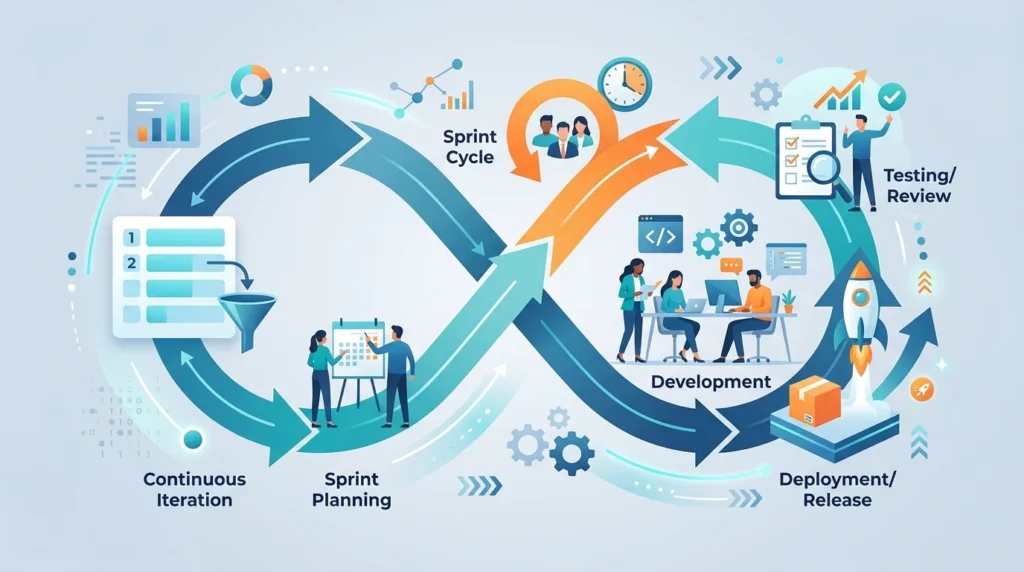
- The Context-Switching Penalty: When domestic developers submit questions or code reviews to an offshore team and must wait overnight for an answer, they are forced to switch tasks. Research shows it takes an average of 23 minutes to regain deep focus after an interruption, causing compounding cognitive drag across the engineering team.
- Collaboration : Synchronous nearshore collaboration empowers teams to resolve complex technical challenges instantly, enabling real-time agile velocity and highly efficient sprint execution.
- Passive, Ticket-Based Execution: Isolated by time-zone barriers, offshore developers naturally become passive ticket executors who code strictly to rigid specifications—often missing broader system architecture context and architectural optimization opportunities.
4 Technical Edge Cases Powered by Nearshore Staff Augmentation
When you leverage nearshore staff augmentation to embed senior Latin American developers into your team, your technical workflows operate with full synchronous power:
SYNCHRONOUS TECHNICAL CAPABILITIES:
|– 1. Live Pair-Programming & Real-Time Debugging (VS Code Live Share, live terminal sync)
|– 2. Rapid Pull Request (PR) Velocity (Instant code reviews & continuous integration)
|– 3. Synchronous Agile Ceremonies (Active sprint planning, retrospectives & daily stand-ups)
|– 4. Real-Time Incident Response & War Rooms (Instant resolution of live production bugs
1. Live Pair-Programming and Collaborative Architecture
Complex microservices refactors, distributed database schemas, and mission-critical API integrations often require two minds working on the same codebase simultaneously.
With nearshore engineers working in your exact time zone, your senior architects and LatAm developers can jump into VS Code Live Share sessions, co-author unit tests, and resolve complex edge cases collaboratively in real time.
2. Sub-Hour Pull Request (PR) Turnarounds
In high-performing DevOps pipelines, long-lived Git branches are a primary source of merge conflicts and integration bugs.
Nearshore staff augmentation ensures that when a developer opens a PR at 11:00 AM, a peer reviewer conducts the code review by 11:30 AM. Branches are merged rapidly, CI/CD pipelines run continuously, and features move to staging on the same business day.
3. Meaningful Sprint Ceremonies & Backlog Grooming
Instead of one-way status reporting, your entire engineering pod gathers synchronously on Zoom or Google Meet:
- Sprint Planning: LatAm engineers actively estimate story points, challenge architectural assumptions, and identify technical debt.
- Global Hiring: By optimizing domestic and global hiring strategies, companies can accelerate development timelines, maintain robust engineering capacity, and capture significant market share.
- Backlog Grooming: Product managers, UI/UX designers, and engineers align user stories with technical feasibility before sprints begin.
4. Real-Time Incident Response & Production Debugging
Implementing a strategic, globally distributed talent model empowers your organization to scale operations effortlessly and drive continuous innovation.
With nearshore engineers online during standard U.S. business hours, your augmented team members join the emergency debugging war room immediately to inspect logs, push hotfixes, and restore uptime.
Side-by-Side Comparison: Far-Shore Contracting vs. Nearshore Staff Augmentation
Sprint & Workflow Dimension
Far-Shore Contractors (Asia / SE Asia
Nearshore Staff Augmentation (Radar Hire)
Time-Zone Alignment
10 to 14 Hours Offset (Night-shift fatigue)
0 to 2 Hours (Complete U.S. Business Hours Overlap)
Daily Communication Window
1 to 2 Hours (Late night / Early morning)
8 Full Synchronous Working Hours (EST/CST/PST)
PR Review Turnaround
24 Hours (Asynchronous delay)
15 to 45 Minutes (Real-time code review)
Pair-Programming Feasibility
Impractical (Requires scheduling days ahead)
Frictionless (Spontaneous Slack huddles & screen shares)
Agile Ceremony Engagement
Passive (Async Jira updates / recorded videos)
Active (Live sprint planning, stand-ups & retrospectives)
Production Hotfix Speed
Delayed until overseas shift starts
Immediate; real-time incident resolution
Engineering Culture
Disconnected “Third-party vendor”
Fully embedded, dedicated core team member
Total Sprint Output
Frequent sprint drag and slipped releases
High-velocity, continuous daily production deploys
The Latin American Engineering Advantage: Seniority and Scale
Latin America has developed into one of the world’s most dynamic software development hubs, producing over 300,000 STEM and computer science graduates annually:
LATIN AMERICAN TECHNICAL HUBS:
|– Brazil: Enterprise Java, distributed backends, Data Science, PIX fintech architecture.
|– Mexico: Full-stack web/mobile (React, Node, Python), cloud DevOps, USMCA IP security.
|– Colombia & Argentina: Modern SaaS frontend architectures, AI integrations, Golang microservices.
Why LatAm Engineers Excel in U.S. Tech Stacks:
- Deep Stack Modernity: LatAm software engineers build with modern web and cloud technologies: TypeScript, Next.js, Python, Golang, Docker, Kubernetes, AWS, and modern generative AI frameworks.
- Native Technical English: Candidates are vetted for clear verbal communication, active listening, and technical documentation proficiency.
- Flat-Hierarchy Assertiveness: Unlike traditional overseas cultures where questioning a manager is discouraged, Latin American engineers are culturally comfortable engaging in collaborative, candid technical debate to build better software.
How Radar Hire Engineers Seamless Nearshore Integration
At Radar Hire, we don’t just supply remote resumes; we specialize in nearshore staff augmentation engineered for high-velocity software teams.
We match your engineering organization with the top 1% of bilingual Latin American developers who seamlessly integrate into your daily Agile rituals from Day One:
THE Radar Hire TECHNICAL INTEGRATION PIPELINE:
|– 1. Custom Tech Stack Matching (React, Node, Python, Java, Golang, AWS, Kubernetes)
|– 2. Live Proctored Coding & Architecture Defense (Live coding audits by senior engineers)
|– 3. 5-Day Candidate Shortlist (Interview 2-3 pre-vetted senior finalists in under a week)
|– 4. Turnkey EOR & Legal Shield (U.S. contracts, Delaware jurisdiction, full compliance)
The Radar Hire Agile Guarantee:
- The Top 1% Filter: Every candidate undergoes live coding evaluations, architectural system design challenges, and English communication testing.
- 100% Time-Zone Synchronization: Engineers work during your exact operating hours (EST, CST, MST, PST) for live Slack messaging, stand-ups, and real-time pair-programming.
- U.S. Legal & IP Protection: All engagements are backed by enforceable U.S. contracts, Delaware-standard corporate governance, and ironclad IP Assignment protections.
- Turnkey EOR Management: We manage all local Latin American labor compliance, statutory benefits, and payroll with zero administrative overhead.
- 50% to 65% Cost Optimization: Build a high-performance, senior engineering pod at a fraction of domestic Silicon Valley or New York compensation benchmarks.
Frequently Asked Questions (FAQs)
Why does time-zone alignment matter so much for Agile software development?
By optimizing domestic and global hiring strategies, companies can accelerate development timelines, maintain robust engineering capacity, and capture significant market share.
What technical stacks do nearshore staff augmentation developers specialize in?
Nearshore engineers in Latin America specialize in modern enterprise and startup stacks—including frontend (React, Next.js, Vue), backend (Node.js, Python, Java/Spring Boot, Golang, .NET), mobile (React Native, Flutter, Swift), cloud/DevOps (AWS, GCP, Kubernetes, Docker, Terraform), and AI/ML pipelines.
How quickly can Radar Hire integrate a nearshore developer into our sprint cycle?
Radar Hire delivers a curated shortlist of pre-vetted, top 1% candidates within 5 business days. Following client interviews, onboarding and system integration into your Jira, GitHub, and Slack environments typically take less than one week.
Supercharge Your Sprint Velocity with Radar Hire
By optimizing domestic and global hiring strategies, companies can accelerate development timelines, maintain robust engineering capacity, and capture significant market share.