
Philippines Talent
Data Privacy and IP Security: What U.S. Firms Must Know About Outsourcing to the Philippines
🕑 9 min read 💻 Philippines Talent
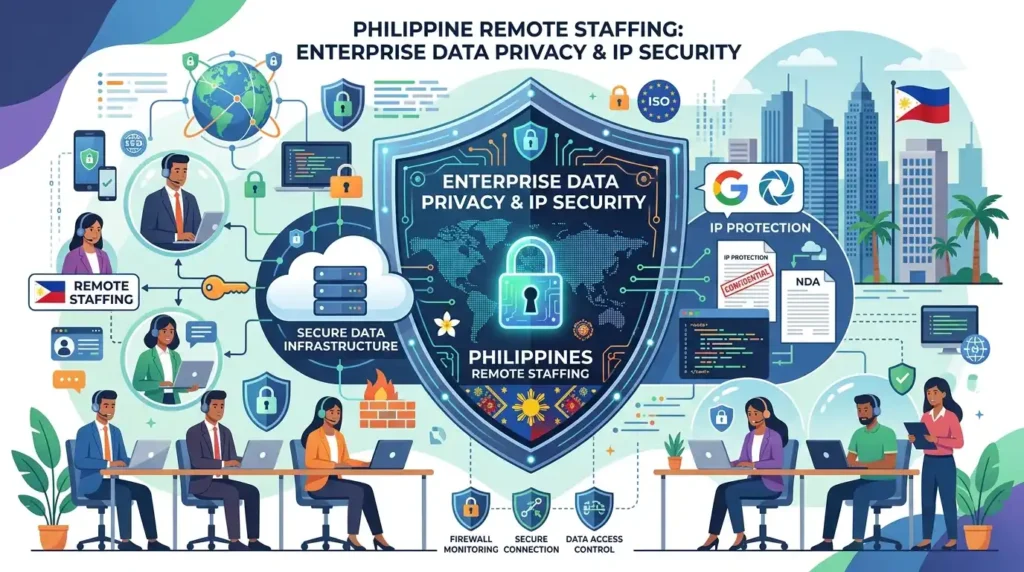
For U.S. leadership teams in healthcare, fintech, legal services, SaaS, and e-commerce, global expansion presents an undeniable operational dilemma:
While the cost efficiency and high emotional intelligence of global talent are well established, risk-conscious executives—including Chief Information Security Officers (CISOs), General Counsels, and compliance directors—face a critical question before greenlighting any international placement:
“How do we guarantee that our proprietary customer data, client lists, and core intellectual property remain 100% secure when outsourcing overseas?”
In the early days of global contracting, offshore data security was often viewed with skepticism. Unregulated freelancer platforms and unvetted contractors operating on personal laptops without enforceable contracts created justifiable concern around data leaks and intellectual property theft.
However, the regulatory and compliance landscape has fundamentally evolved. Today, outsourcing to the Philippines is backed by one of the most comprehensive, enterprise-aligned data protection frameworks in the world: The Data Privacy Act of 2012 (Republic Act No. 10173).
Modeled directly after international benchmarks like the European Union’s GDPR and aligned with U.S. security standards, the Philippines offers robust legal and technical protections for international businesses.
In this guide, we break down the legal protections of the Data Privacy Act of 2012, explain how the Philippines safeguards foreign corporate data, and reveal the multi-layered security framework RadarHire deploys to protect your enterprise assets.
Executive Summary: Enterprise-Grade Data Security
- The Security Hesitation: U.S. executives worry that sending sensitive customer databases, financial records, or proprietary workflows abroad introduces unmitigated legal risk and compliance exposure.
- The Legal Foundation: The Philippines’ Data Privacy Act of 2012 (DPA) establishes strict statutory mandates for data handling, cross-border data transfers, and severe criminal and civil penalties for unauthorized data disclosure.
- The Managed Security Shield: Partnering with a premium staffing agency like RadarHire layers Zero-Trust access architecture, bilateral NDAs, endpoint governance, and Employer of Record (EOR) compliance on top of statutory protections—ensuring complete data confidentiality.
Understanding the Legal Shield: The Data Privacy Act of 2012
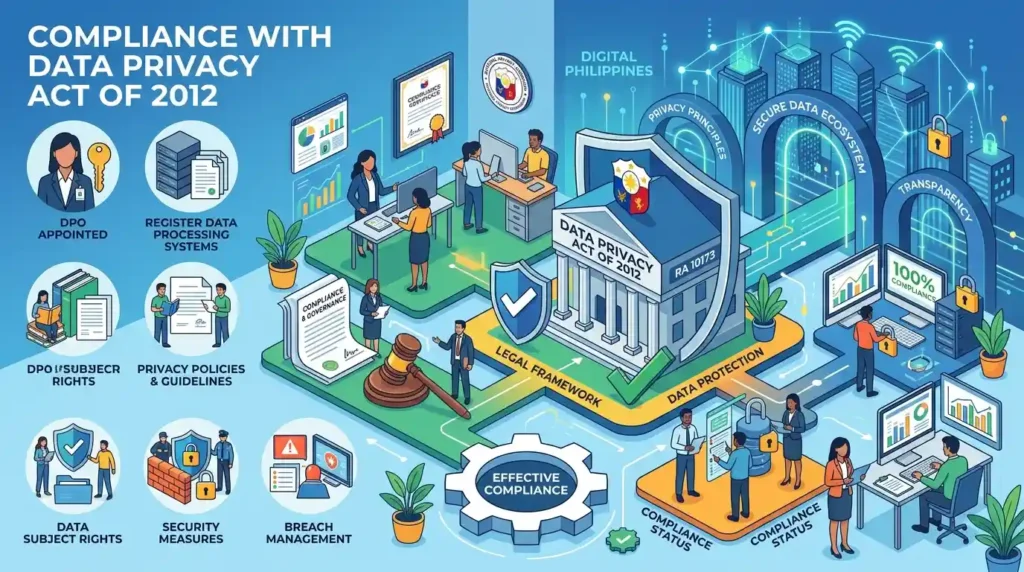
In 2012, the Philippine government enacted Republic Act No. 10173 (The Data Privacy Act) specifically to position the country as a world-class, legally secure hub for global information technology and business operations.
Governed and actively enforced by the National Privacy Commission (NPC), the DPA closely mirrors the strict standards of the EU’s General Data Protection Regulation (GDPR) and U.S. privacy frameworks:
THE PHILIPPINE DATA PRIVACY ACT (RA 10173) CORE PILLARS:
1. Mandatory Data Subject Consent & Transparency (Strict rules on PII collection & storage)
2. Cross-Border Data Transfer Accountability (Direct liability for unauthorized data handling)
3. Severe Criminal & Financial Penalties (Imprisonment up to 6 years & multi-million peso fines)
4. Mandatory Breach Notification Protocols (Strict 72-hour reporting mandates to the NPC)
GLOBAL DATA PROTECTION ALIGNMENT:
European Union (GDPR) <– Direct Statutory Parity –> Philippines (DPA 2012)
|
Compliant with U.S. Standards:
[ SOC 2 * HIPAA * FINRA * CCPA ]
Why the DPA Gives U.S. Firms Direct Legal Protection:
- Extraterritorial Jurisdiction: The DPA explicitly applies to processing personal information about foreign citizens if the data controller or processor has direct ties to the Philippines—giving U.S. corporate data direct statutory protection.
- Criminal Liability for Data Theft: Unlike jurisdictions where IP misappropriation is treated solely as a minor civil dispute, the DPA imposes mandatory prison sentences (up to 6 years) and heavy financial fines for unauthorized data disclosure, intentional breaches, and malicious processing.
- Data Protection Officer (DPO) Requirements: Corporate entities handling high-volume data must appoint accredited DPOs to oversee data hygiene, audit trails, and access permissions.
The Risk Gap: Unregulated Gig Platforms vs. Premium Managed Outsourcing
Ensuring robust data security is a priority when assembling a remote workforce. Understanding the contrast between standard open marketplace arrangements and a compliant, fully-managed staffing model is essential for optimal risk mitigation:
UNMANAGED FREELANCER (High Security Exposure):
[ Personal Laptop ] -> [ Plaintext Password Sharing ] -> [ Unrestricted File Downloads ] -> [ Zero Enforceability ]
RADARHIRE MANAGED SECURITY ARCHITECTURE (Enterprise Grade):
[ Vetted Identity ] -> [ Zero-Trust Password Vault ] -> [ Role-Based Cloud Access ] -> [ 100% Enforceable IP / NDAs ]
4 Security Safeguards RadarHire Deploys for Total Asset Protection
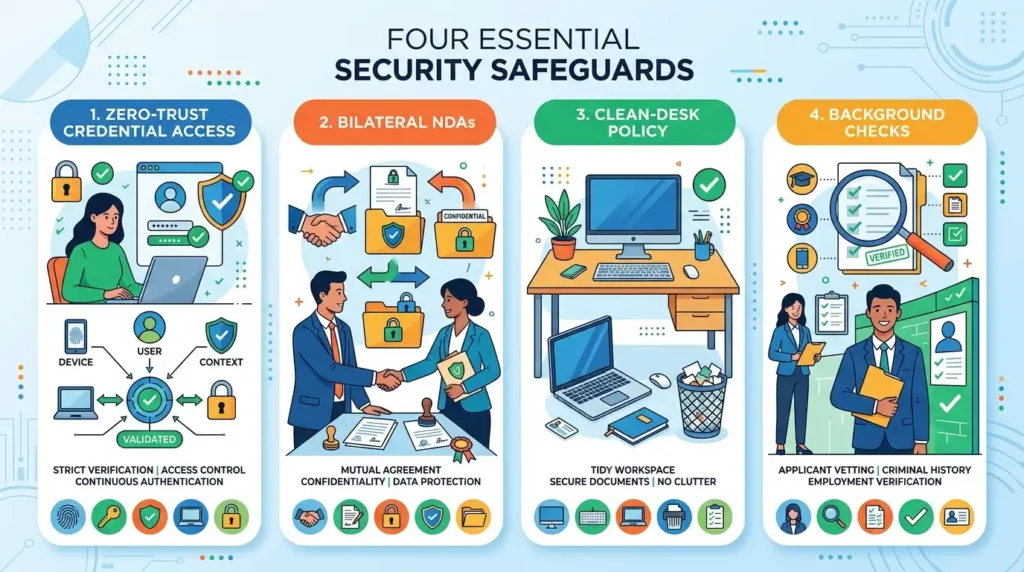
When your company is outsourcing to the Philippines through RadarHire, statutory legal protections are reinforced with enterprise-level operational security:
THE RADARHIRE 4-LAYER DATA DEFENSE SYSTEM:
LAYER 1: Comprehensive Background & Integrity Audits (Identity & criminal verification)
LAYER 2: Enforceable Bilateral NDAs & IP Assignment (100% client asset ownership)
LAYER 3: Zero-Trust Access & Credential Encryption (LastPass, Okta SSO, VDI/VPN)
LAYER 4: Continuous IT Endpoint Governance & Data Wiping (Automated offboarding)
1. Rigorous Background & Integrity Screening
Before entering your workflow, every candidate undergoes thorough vetting:
- Government-Issued ID Verification: Verification of national passports, tax identification numbers (TIN), and biometric records.
- National Police & NBI Clearance: Official criminal background checks via the National Bureau of Investigation (NBI) in the Philippines.
- Past Employment Audits: Direct verification with former supervisors evaluating trustworthiness, confidentiality compliance, and professional ethics.
2. Legally Binding Bilateral NDAs and IP Assignment Contracts
To ensure your trade secrets, customer databases, and proprietary workflows remain 100% your property:
- Every remote employee signs customized, ironclad Non-Disclosure Agreements (NDAs) and Intellectual Property (IP) Assignment Agreements.
- Contracts are structured under compliant Employer of Record (EOR) frameworks to ensure full enforceability in both Philippine courts and U.S. jurisdictions.
3. Zero-Trust Credential & System Access Protocols
We eliminate the risk of password sharing and unmanaged data access:
- Encrypted Password Management: Talent accesses your toolstack using secure credential vaults (such as LastPass, 1Password, or Okta SSO), ensuring workers never view or store plain-text master credentials.
- Role-Based Permissions: Restricting file-download permissions, export capabilities, and administrative access to necessary operational scopes only.
- Virtual Desktop Infrastructure (VDI) & VPNs: Where required, talent works inside isolated, client-approved virtual environments that prevent local data caching or USB transfers.
4. Clean-Desk Policies and Immediate Offboarding Protocols
For roles handling high-sensitivity financial records, legal files, or customer PII:
- Strict Confidentiality Protocols: Clear guidelines prohibiting the photographing of screens, external note-taking of PII, or working from unsecured public networks.
- Instantaneous Access Revocation: In the event of team role transitions or offboarding, our systems execute immediate centralized credential revocation across all connected platforms.
Side-by-Side Comparison: Sourcing Security Standards
Security & Compliance Dimension
Open Freelance Marketplaces
Traditional Far-Shore Call Center
RadarHire Managed Placement (Philippines)
Data Protection Governancec
None (Basic platform TOS)
Rigid vendor SLA (Opaque controls)
Data Privacy Act of 2012 + GDPR Parity
Identity Verification
Basic email signup
Group hiring (High proxy risk)
Biometric facial check + Official NBI clearance
IP Rights & Enforceability
Vague / Non-enforceable abroad
Vendor owns technical process
100% Client-owned via bilateral legal IP contracts
Access Control Protocol
Direct password sharing
On-premise physical terminals
Zero-Trust SSO, Password Vaults & Encrypted VPNs
Regulatory Compliance Fit
Fails security audits
Heavy change-order overhead
Pre-aligned for SOC 2, HIPAA, FINRA, & CCPA
Offboarding Data Security
Manual / Trust-based
Vendor-managed
Automated, instantaneous centralized access wipe
Industry-Specific Compliance Alignment
Different regulated industries face distinct compliance standards when scaling offshore. Philippine professionals placed through RadarHire operate seamlessly within these frameworks:
1. Healthcare & Healthtech (HIPAA Alignment)
- Safeguards: Remote staff access Electronic Health Records (EHR) through encrypted VDI sessions with restricted local printing and downloading, maintaining strict HIPAA privacy safeguards.
2. Financial Services & Fintech (SOC 2 & FINRA Alignment)
- Safeguards: Dual-factor authentication (2FA), immutable audit logging, clean-desk confidentiality compliance, and zero local credential storage.
3. Legal & Corporate Professional Services
- Safeguards: Strict multi-jurisdictional NDAs, role-based document partitioning, and end-to-end encrypted communication channels protecting attorney-client privilege.
Why RadarHire Is the Trusted Partner for Secure Philippine Outsourcing
At RadarHire, we believe that global talent scaling should enhance your operational resilience, never introduce compliance or data vulnerabilities. When you partner with us for outsourcing to the Philippines, you receive dedicated, pre-vetted professionals backed by an institutional compliance shield.
The RadarHire Security & Quality Commitment:
- Top 1% Integrity-Vetted Talent: Comprehensive background screenings, NBI clearances, technical assessments, and native-level English evaluations.
- 100% U.S. Time-Zone Synchronization: Talent works during your exact operating hours (EST, CST, MST, PST) for live Slack collaboration and synchronous team syncs.
- Turnkey EOR & Legal Compliance: We manage all Philippine labor laws (DOLE), statutory benefits (SSS, PhilHealth, Pag-IBIG), 13th-month pay, and cross-border payroll seamlessly.
- Complete IP & Data Integrity: Bilateral legal protections, Zero-Trust access setups, and ongoing account governance give you total peace of mind.
- 50% to 65% Cost Optimization: Scale your technical, customer success, and operational teams while maintaining enterprise-grade security standards.
Frequently Asked Questions (FAQs)
How does the Philippine Data Privacy Act protect my U.S. company's data?
The Philippine Data Privacy Act of 2012 (RA 10173) strictly regulates the collection, storage, and processing of personal data, imposing severe criminal penalties (including imprisonment) and heavy fines for unauthorized disclosure, breaches, or data theft—offering legal parity with international standards like GDPR.
How do I prevent remote staff from downloading or stealing proprietary client lists?
By implementing Zero-Trust access architecture—such as restricting local export/download permissions in your CRM (HubSpot/Salesforce), using password managers (LastPass/1Password), and utilizing virtual desktop infrastructure (VDI)—remote staff perform their duties without ever possessing downloadable local copies of sensitive datasets.
Are NDAs signed with remote employees in the Philippines legally enforceable?
Yes. When executed through RadarHire's compliant Employer of Record (EOR) structure, employment contracts, confidentiality agreements, and IP assignment clauses are fully recognized and enforceable under Philippine labor law and international jurisdiction.
Scale Your Operations with Enterprise-Grade Security
Don’t let data security fears hold your business back from world-class global talent. Partner with RadarHire to leverage the power of outsourcing to the Philippines with complete data privacy, legal certainty, and operational excellence.