Remote Staffing
Remote Staffing vs. Freelance Marketplaces: Why Specialized Firms Win for Long-Term Scaling
🕑 10 min read 💻 Remote staffing

As businesses attempt to scale in an increasingly digital and globalized economy, the demand for flexible, high-performing talent has never been higher. When building a remote team, leadership teams usually gravitate toward one of two paths: freelance marketplaces (like Upwork or Fiverr) or a dedicated remote staffing company.
While gig platforms offer fast, project-based fulfillment for temporary needs, growing companies often find that transactional marketplaces create significant operational friction over time. Unlike dedicated talent models, relying on gig workers for core operational workflows can limit long-term team cohesion and workflow consistency.
In this guide, we break down why scaling businesses require a true partnership model and how choosing a specialized remote staffing company provides the structure, retention, and integration needed for sustainable, long-term growth.
Executive Summary: At a Glance
- Freelance Marketplaces (Gig Platforms): Designed for transactional, short-term tasks. While providing high candidate volume, the gig model offers limited retention assurances and variable skill alignment compared to the dedicated, full-time operational scaling of Specialized Remote Staffing Companies.
- Specialized Remote Staffing Companies: Designed for dedicated, full-time or long-term operational scaling. Candidates are pre-vetted, culturally aligned, and backed by ongoing administrative and onboarding support.
The Strategic Shift: Task execution solves a temporary backlog; dedicated talent builds compounding institutional knowledge.
The Gig Economy Approach: Short-Term Task Execution vs. Sustainable Growth
When a company experiences rapid growth, the immediate reaction is often to plug talent gaps as quickly as possible. Freelance marketplaces make this tempting: you log on, post a job description, and receive dozens of proposals within hours.
However, gig platforms are built on a transactional framework. The freelancer’s priority is maximizing project throughput across multiple clients simultaneously. They are incentivized to complete a specific deliverables list and move on to the next contract.
- Transactional Freelance Model: Job Post → Bidding War → Task Execution → Offboarding / Churn
- Dedicated Remote Staffing Model: Needs Assessment → Rigorous Vetting → Onboarding & Culture → Compounding Growth
When building key operational functions-such as customer success, technical support, digital marketing management, or sales development-task execution is not enough. Scaling requires ownership, context, and continuity. Frequent re-onboarding of new freelancers for every assignment can require leadership to allocate significant bandwidth to project management rather than strategic business growth.
The Comprehensive Costs of Freelance Marketplaces
While freelance platforms advertise low initial hourly rates, the true total cost of ownership (TCO) often includes additional operational investments:

1. Navigating Talent Transitions
Because freelancers operate independently across multiple client accounts, they naturally focus on short-term engagements rather than long-term team integration. When personal schedules or priorities shift, freelancers may transition away from ongoing projects unexpectedly. When a contractor departs, organizations often need to reinvest time in recruiting and onboarding to rebuild institutional knowledge.
2. Comprehensive Talent Evaluation and Verification
Online marketplaces provide access to a broad range of professionals, making a structured evaluation process valuable for identifying candidates whose skills, experience, and expertise align with your business objectives.
3. Building Strong Cultural Integration
Dedicated onboarding, regular team collaboration, and shared business goals help remote professionals become active contributors to your company culture while strengthening teamwork, engagement, and long-term success.
How a Dedicated Remote Staffing Company Differs
A specialized remote staffing company shifts the dynamic from a one-off gig transaction to a strategic talent partnership. Rather than acting as a self-serve marketplace, a remote staffing partner takes full accountability for recruiting, vetting, onboarding, and supporting talent tailored specifically to your business goals.
Feature
Freelance Marketplace
Remote Staffing Firm
Talent Model
Project-based Gig
Dedicated / Long-term
Vetting Process
Self-reported / Automated
Rigorous Multi-stage Assessment
Culture Fit
Minimal to None
Deep Integration & Alignment
Talent Retention
Low (High Churn)
High (Supported HR & Retention)
Management Overhead
High (You handle everything)
Low (Supported Management Framework)
1. Rigorous, Multi-Stage Vetting
Unlike open marketplaces where anyone can publish a profile, a professional remote staffing firm evaluates candidate technical competencies, English proficiency, soft skills, and problem-solving abilities before they ever reach your inbox. Only the top 1% to 3% of candidates pass through to the interview stage.
2. Seamless Cultural & Operational Integration

A dedicated remote employee works exclusively for your company during their set business hours. They utilize your communication channels (Slack, Teams, email), adhere to your security policies, and adapt to your internal processes. They aren’t balancing five other clients-they are an extension of your core team.
3. Retention, Benefits, and Infrastructure Support
Top-tier remote staffing companies handle HR administration, payroll compliance, benefits, localized legal frameworks, and equipment setup. By providing talent with competitive compensation, professional growth paths, and stability, staffing firms deliver significantly higher retention rates than unmanaged gig platforms.
Side-by-Side Comparison: Evaluating Your Talent Strategy
Feature / Criteria
Freelance Marketplace (e.g., Upwork)
Specialized Remote Staffing Firm
Primary Focus
Short-term tasks & quick gigs
Long-term scaling & dedicated roles
Candidate Sourcing
Open marketplace / Self-promoted
Tailored headhunting & skill matching
Commitment Level
Non-exclusive, multi-client focus
100% Dedicated to your organization
Onboarding Support
None (Self-managed)
Guided onboarding & workflow alignment
Retention Strategy
None (High turnover)
Ongoing HR support & talent development
Scalability
Fragile (Rebuilding teams repeatedly)
Robust (Repeatable playbook for team growth)
Building a Scalable Remote Team with RadarHire
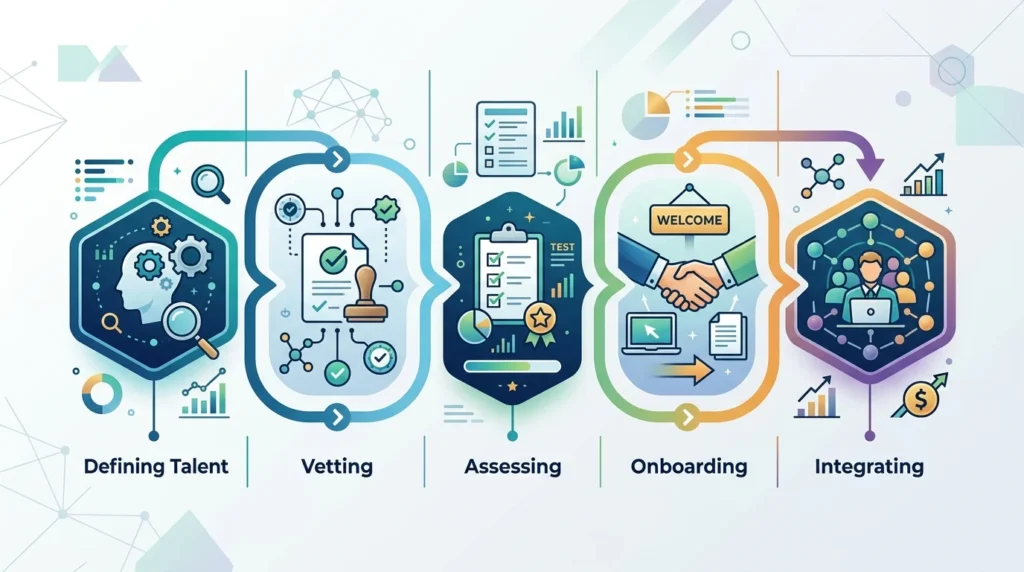
When scaling operations, speed should not come at the expense of stability. RadarHire helps high-growth businesses replace the unpredictability of gig marketplaces with reliable, elite remote talent.
By combining rigorous global candidate sourcing with structured onboarding and ongoing administrative management, RadarHire enables company leaders to scale their teams effortlessly.
Why Growing Companies Choose RadarHire:
- Pre-Vetted Global Talent: Gain immediate access to highly skilled professionals across technology, operations, customer success, and digital marketing.
- Turnkey HR & Compliance: We manage payroll, compliance, and localized contracts so you can focus entirely on driving business results.
- Dedicated Integration: Talent works exclusively in your time zone, embedded within your existing toolstack and workflows.
- Long-Term Retention Guarantees: Enjoy continuous support and account management designed to ensure team stability and long-term success.
Frequently Asked Questions (FAQs)
What is the difference between a freelance marketplace and a remote staffing company?
A freelance marketplace is an open directory where independent contractors bid on short-term tasks. A remote staffing company is a managed service partner that sources, vets, hires, and retains dedicated full-time talent tailored specifically to your company's operational requirements.
How do freelancers typically manage multiple projects on gig platforms?
Freelancers on open platforms work independently and often manage multiple client engagements simultaneously. Businesses seeking long-term continuity and dedicated collaboration may benefit from professionals who are fully aligned with a single team and its objectives.
Is hiring through a remote staffing company more expensive than using Upwork?
While hourly rates on gig marketplaces appear lower upfront, the indirect costs associated with management transition, ongoing screening, and knowledge transfer can increase the total long-term investment. A remote staffing partner offers a predictable cost structure with drastically higher return on investment.
Ready to Scale Your Team with Dedicated Talent?
Reclaim your time from managing individual gig bids and navigating talent transitions. Partner with RadarHire to build a dedicated, high-performing remote team designed for long-term growth.